Case Study · Management Consulting · Amsterdam, Netherlands
A bespoke SuperCollaboration™ keynote that gave 700 senior strategy consultants a new understanding of their competitive advantage in the age of AI.
At a Glance
| Detail | Information |
|---|---|
| Client | A leading global strategy consulting firm — one of the world's foremost strategy houses |
| Industry | Management Consulting / Professional Services |
| Event Type | Opening Keynote — 30 minutes |
| Audience | 600–700 strategy consultants (Associate to Partner level) plus internal leadership; average age ~30; multiple European countries |
| Location | Amsterdam, Netherlands — Europe All-Hands Meeting |
| Challenge | A senior audience that advises Fortune 500 CEOs and has heard most AI keynotes — generic doesn't land |
| Solution | Bespoke SuperCollaboration™ keynote built from scratch around three executive alignment calls and deep audience research |
| Outcome | 700 consultants reframed their understanding of competitive advantage; collaborative culture repositioned as structural moat against AI commoditisation |
The Challenge
A leading global strategy consulting firm gathered its full European team in Amsterdam in May 2026 — the first time the group had come together in many years. This was an audience of 600–700 professionals who advise boards and Fortune 500 CEOs on their most consequential strategic decisions. They follow AI developments closely, read the primary research, and form their own views. A keynote that told them "AI is changing everything" was never going to hold the room.
The programme committee's brief was precise: they needed an externally credible, cross-industry perspective on AI and the future of strategy consulting — delivered under the event's Growth pillar — that would leave a highly sophisticated audience with insights they could act on the following Monday. Not broad commentary they had already read, and not a talk that condescended to experts.
The challenge ran deeper than topic selection. The firm was navigating a pivotal internal moment. AI was reshaping client expectations about who does analytical work and at what cost. Younger consultants were asking not just whether they would have jobs, but what their competitive advantage would be. The programme committee needed a speaker who had done enough homework to speak to that question directly.
"What makes an AI keynote credible to a senior strategy consulting audience? The answer comes down to two things: preparation depth and peer-level tone. A consulting audience that advises Fortune 500 CEOs expects the speaker to have studied their specific world — their clients, their competitive pressures, and the questions they're carrying into the room — before walking on stage. Evidence-based rigour, framed in the language of strategy rather than technology, is the only register that lands."
Bespoke by Design
James conducted three in-depth alignment calls with senior leaders ahead of the event — with the Europe Managing Director, the Head of Marketing and Communications, and a senior Partner. Those conversations went well beyond a standard pre-event briefing. They revealed a specific internal tension the audience was living with: AI was increasingly commoditising analytical work — the traditional core of the consulting model — and the firm held an underused asset that had never been explicitly connected to the AI opportunity.
That asset was a deeply collaborative culture that consistently outranked competitors in client satisfaction surveys. James's preparation turned that insight into the spine of the keynote: collaborative capability isn't a soft attribute. In an era where AI handles an increasing share of analysis, it is a structural competitive moat. Every story, data point, and question in the keynote was selected to make that argument land with an audience of strategists.
Learn about the Taylor-Made Process →Three sessions with the Europe MD, Head of MarComms, and a senior Partner to surface audience pressures, client themes, and the questions the room was carrying in.
Profiling of the attendee group to calibrate content density, tone, and delivery style to the way this audience thinks and processes information.
James identified the competitive moat insight — collaborative culture as structural advantage in the AI era — and built the keynote architecture around it.
Stories, data, four cross-industry examples, and three specific takeaways constructed from scratch. Nothing repurposed from a generic deck.
The Delivery
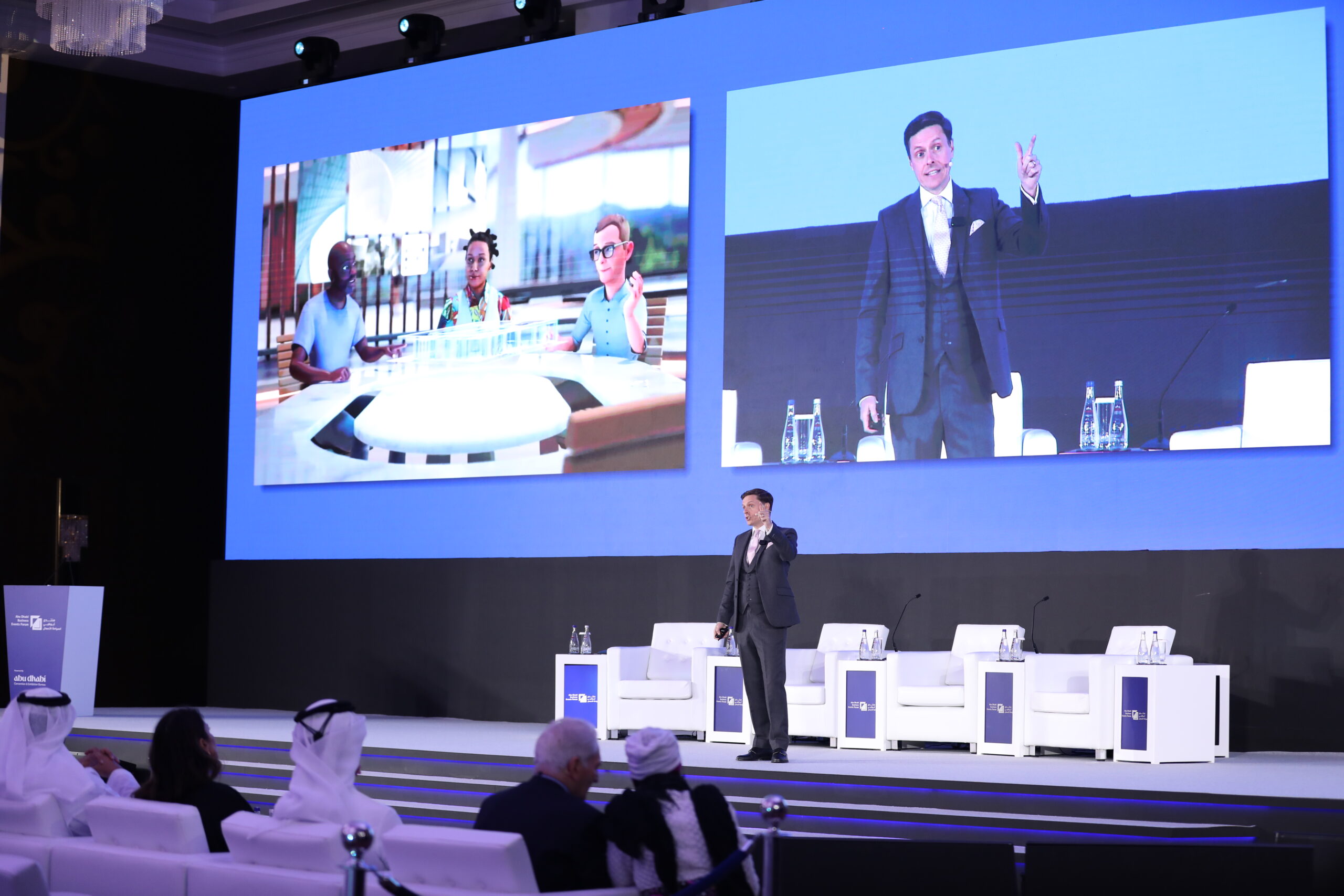
The 30-minute keynote followed James's 4P framework — Position, Problem, Possibilities, Proposal. It opened with a story that established the existential question the audience was already asking but hadn't said out loud: what does human expertise look like when AI can perform significant parts of the analytical work that the traditional consulting model is built around?
From that foundation, the keynote moved through the specific structural and human challenges facing strategy consultants in the age of AI. The Possibilities section brought four cross-industry examples of SuperCollaboration™ working at the highest level — drawn from technology, manufacturing, and professional services — each chosen for direct applicability to consulting work. These weren't abstract AI stories. They were proof points for the argument that collaborative human judgment, properly structured, outperforms AI alone at the level of strategic insight.
The keynote closed with three takeaways the audience could act on the following Monday. The content was built to feed directly into the client panel discussion that followed, with deliberate provocations left open for panellists to pick up.
What Was Delivered
James's core framework for how humans and AI work at their best together — the Cyborg and Centaur models for knowledge workers building competitive advantage in an AI-augmented world.
Explore →Position, Problem, Possibilities, Proposal — the narrative architecture James uses to take senior audiences from the question they're already asking to the answer they can act on.
Explore →Three executive alignment calls, psychometric audience profiling, and original insight development — not a repurposed deck. The keynote spine was built around a discovery unique to this firm.
Explore →The Results
Takeaways consultants could act on the following Monday
"James Taylor's engagement for this leading global strategy consulting firm showed what a bespoke AI keynote can deliver when the preparation goes beyond the brief. By conducting three executive alignment calls, running psychometric audience analysis, and building original insight around the firm's specific competitive position, James gave 700 senior consultants a reframed understanding of where their advantage lies in the age of AI. Several of the keynote's arguments were picked up directly by panellists in the session that followed."
About the Speaker
James Taylor is an award-winning keynote speaker, entrepreneur, and author whose work sits at the intersection of human creativity, collaboration, and artificial intelligence. Holding an MBA and elected a Fellow of the Royal Society of Arts (FRSA), he has delivered more than 3,000 presentations across 50+ countries for organisations including Apple, IBM, Visa, Deloitte, and Accenture. His SuperCollaboration™ framework helps senior leadership teams in management consulting and professional services understand how human expertise and AI capability work at their best together.
James works with strategy consulting firms, professional services organisations, and financial services leaders navigating the AI transition. His Taylor-Made preparation process ensures every engagement is built around a genuine insight — not repurposed from a previous stage.
Book James for Your Event⏱ James's team responds within 24 hours