James Taylor (00:00)
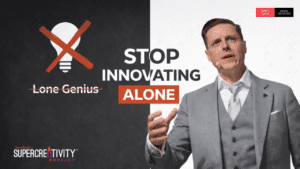
One of the most persistent myths in business is that great breakthroughs come from a lone genius working in isolation. But if you look backstage at the most successful companies in history, that you'll find that innovation is really a solo act. It's a team sport and it often starts with the power of two. Think about the legendary partnership of Steve Jobs and Steve Wozniak. Jobs once said that Apple simply wouldn't exist

without Wozniak's great engineering mind. Later, it was Jobs' collaboration with the British designer, Joni Ive, that drove Apple's golden design era. Now, these weren't just two people working in the same building. They were what we call super ties, long-term creative duos who sat at a point of production tension. They didn't agree with each other.

And that tension is actually something quite remarkable and quite marvelous in creativity. And the benefits of creative pairing aren't just anecdotal, they're backed by hard data. A recent study of more than 166,000 scientific collaborations found these long-term duos led to papers receiving 17 % more citations on average than those written with one-off collaborators. Even more striking though,

was an analysis of nearly 20 million academic papers and two million patents showing that team authored work is cited more than twice as often as solo work. In fact, home run breakthroughs, which are those cited over 100 times, were six times more likely to merge from teams than from individuals. So it's pretty clear.

about the power of these, I like to call creative pairs. So why does the power of two work so well? Well, it's because creative pairs often sit at the point of a productive friction. They have the visionary and the implementer, the dreamer and the realist, the provocateur and the editor. They don't dilute the work, they help distill it and craft it.

They respect each other to challenge each other's assumptions, to strip away the non-essentials and sharpen the core idea until it's bulletproof. And I know in my own work, I've seen this resilience built through what I like to call the barbell model of mentorship. I can't remember who first told me about this way of thinking about creative pairs but I want to share it with you today. So on one end of the barbell,

You have someone ahead of you, perhaps a ⁓ mentor who helps you avoid the blind spots. Someone that's maybe been in your industry for many, many years understands all the pitfalls. But on the other end, you also want to have someone newer to the field as a mentor, as ⁓ a mentor with fresh eyes who asks the questions perhaps that you've stopped asking. In between, you get stronger by having these two quite diametrically opposed views.

This week, I want you to find your creative counterweight. I wanna look at your most important project just now and ask, who is the person that challenges me in the best possible way on this project? Who do I trust enough to share perhaps an early stage or a messy idea with, knowing that they'll improve it rather than just approving it? If you've been trying to innovate alone, you're perhaps hitting a performance ceiling. We are really having to move from this age of me.

to the age of we, if you're going to attain mastery of whatever it is that you're trying to attain mastery of. In a world of increasing complexity though, the most valuable thing that you can do is to stop trying to be the smartest person in the room and start focusing on making the room smarter as a whole through greater collaboration. If you're ready to build your own, perhaps brain trust, your own kind of barbell mentoring and unlock your creativity,

and find that great collaborative partner, you can learn more about this way of working by ordering my book, SuperCreativity. You can do that by going to my website, jamestaylor.me, or wherever you prefer to buy your books. It's your field guide to thriving in the age of artificial intelligence. Thanks for watching.