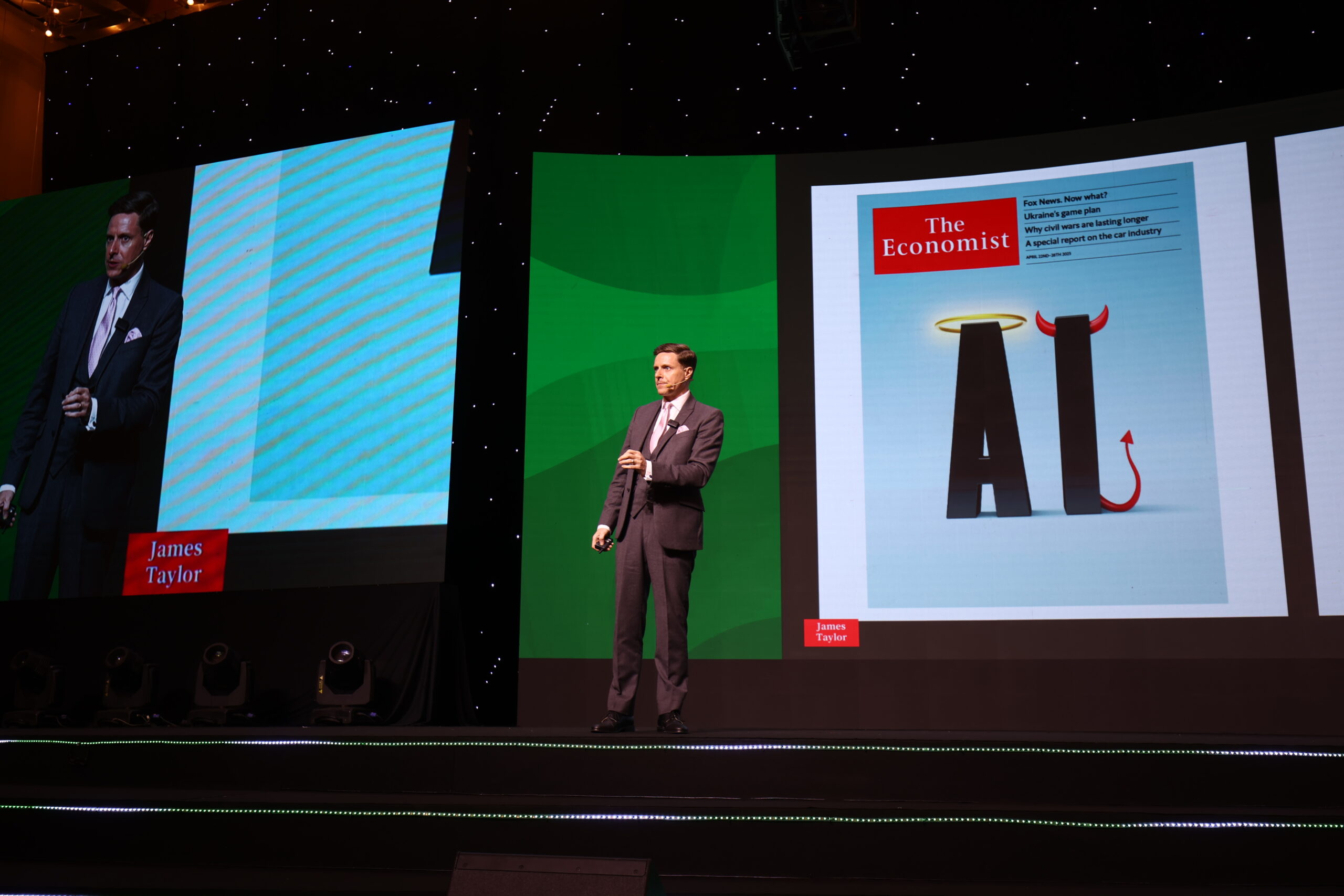
James Taylor in Prague, filmed ahead of his keynote for around 150 general counsel and lawyers. SuperCollaboration series · 4:16.
Episode Timestamps
Approximate. Single continuous take, no chapter markers in the source recording.
- 0:00The idea: bottlenecks and choke points as the key to faster AI adoption
- 0:20Greeting from Prague, with trams going past the window
- 0:40The audience: around 150 general counsel, and the theme of Building Bridges
- 1:05The river, the Charles Bridge and why a bridge is a choke point
- 1:50Bottlenecks in innovation and change management
- 2:10The interactive keynote: workflows that have lasted five to ten years
- 2:40The blocked pipe: velocity through removal, not extra power
- 3:00The "outrageous statements" activity
- 3:20The Starlink story: one bottleneck removed each week
- 3:50Your challenge: name three or four bottlenecks in your business
- 4:05Booking James for an event in Prague or anywhere else
Prague is a city of bridges. Filming from his hotel room with the trams rattling past the window, James Taylor uses that fact to frame a single, sharp idea: the fastest way to speed up AI adoption is often not to add anything, but to remove what is slowing you down.
James recorded this episode of the SuperCollaboration series a few hours before taking the stage as a Prague keynote speaker for around 150 general counsel and lawyers from around the world. The event theme was Building Bridges, and James took it literally.
Why a Bridge Is the Perfect Picture of a Bottleneck
Look out across the Vltava at the Charles Bridge and you are looking at a choke point. A bridge is the narrow crossing that ideas, people and armies have all had to squeeze through. Whoever controls the crossing controls the flow.
"A bridge is a classic choke point. It's a bottleneck."
— James TaylorEvery change programme has its own version of that bridge. In innovation and in change management, there are points where everything narrows, and the pace of the whole organisation is set by how quickly work can get through them. So before asking what to add to speed up AI adoption, James asks a different question: what is blocking the flow?
Remove the Blockage Before You Add More Power
James compares it to a blocked pipe. The instinctive response is to put more power through it: more tools, more budget, more initiatives. But if the pipe is blocked, extra pressure does little. Unblocking it is usually faster.
"How can we increase the velocity by actually removing those things that are slowing stuff down?"
— James TaylorThat reframe matters for anyone leading AI adoption. Velocity does not only come from adding capability. Very often it comes from subtraction.
The Workflows That Served You Well Are Often the Narrowest Points
Here is the uncomfortable part. The choke points are rarely the obviously broken processes. They are often the workflows that have served a business well for five or ten years. Because they worked, nobody questioned them. In the AI era, those same workflows need reimagining, and they are frequently the narrowest points in the system.
That is where James takes his audience in the interactive part of the keynote: into their own long-standing workflows, looking for where the flow gets squeezed.
Want your team working on its own bottlenecks, not just listening to a talk?
Enquire About a KeynoteOne Bottleneck a Week: The Starlink Habit
James offers a simple habit. Each week, focus on removing one bottleneck. The week after, remove another. On their own, the changes look small. Over time, the gains compound, in line with the idea of the aggregation of marginal gains.
To illustrate it, James tells how Elon Musk's team in Seattle took this approach with Starlink in its early days, removing a new bottleneck every week. The point is not the scale of any single fix, it is the rhythm of fixing one thing, every week, without stopping.
Inside an Interactive Keynote: Outrageous Statements
The Prague keynote is not a lecture. James poses a series of what he calls "outrageous statements", each one a different way of thinking about removing bottlenecks, and attendees apply them directly to their own workflows. For a room of general counsel and legal teams, that means looking hard at the processes their work depends on, and asking which of them is now the choke point.
"Not looking to add lots of new things, but just removing things that are slowing you down."
— James TaylorThe format works especially well at internal events. When the people in the room can act on what they identify, a company can move much faster on AI adoption, because the conversation turns into decisions before anyone has left the room.
Your Challenge: Name Three or Four Bottlenecks
James closes with a challenge for every viewer. Name the three or four bottlenecks slowing AI adoption in your own business. Not the new tools you want to buy, the things currently in the way. Then pick one and remove it this week.
Looking for a Keynote Speaker in Prague?
If you are planning a conference, leadership meeting or legal event in Prague, James Taylor delivers interactive keynotes that get audiences working on their own workflows, not just listening. He has spoken at more than 3,000 events in over 50 countries. Explore his AI keynote speaker programmes, the SuperCollaboration keynote, or check his availability for your Prague event or anywhere else in the world.