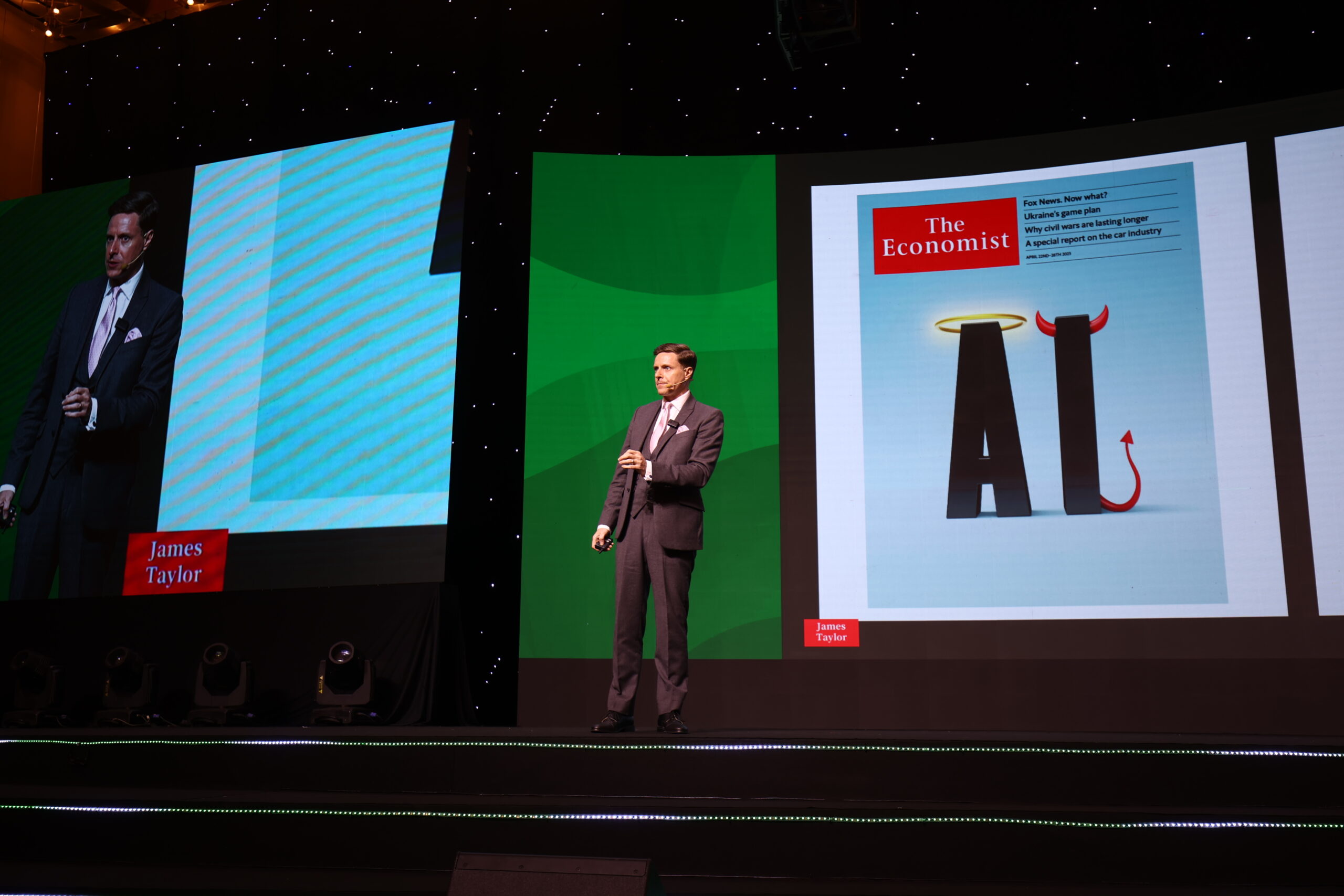
James Taylor in conversation with Galina Fendikevich on Artificial Reality — "How to Get Ahead of 99% of Speakers (with AI)".
Episode Timestamps
- 00:00Highlights
- 00:49Meet James Taylor: Keynote Speaker on Creativity and AI
- 03:39From Managing Rock Stars to 100 Keynotes a Year
- 05:35The AI Chief of Staff That Runs His Morning
- 06:20How He Gets Recommended by ChatGPT and Claude (GEO and AEO)
- 07:35Psychometric Profiles Before Every Sales Call
- 09:00The Claude Story Bank That Drafts His Keynotes
- 12:051,000 People, One Taylor Swift Reggae Song, Made Live With AI
- 14:27The Claude Skill That Writes His Case Studies
- 15:31Claude vs ChatGPT vs Gemini: Why He Isn't Loyal to One Tool
- 16:22Why Cheap AI Won't Last: The Venture Capital Subsidy
- 17:21Could Cheaper Chinese Models Challenge US AI?
- 18:25Five Computers, Five AIs, and Why He Names Them
- 19:22Which Roles AI Replaced on His Team
- 22:58Why Silicon Valley's Job-Loss Message Backfires
- 25:08Cut Jobs or Retrain People? Two Very Different AI Outcomes
- 26:59Problem Solving vs Problem Finding
- 31:51Strategy Swarms: Testing Ideas on Synthetic Citizens
- 34:11Using AI as a Performance Coach
- 35:39His Virtual Mastermind With Warren Buffett and Bruce Lee
- 37:14Why AI Models Carry a Western Bias
- 39:44Where AI Falls Short: Cold Outreach and AI Avatars
- 42:30The SoftBank Button That Calms Angry Callers
- 44:47What He Wants Built: An AI Presentation Coach
- 46:23How Jensen Huang's Storytelling Moved Nvidia's Stock
- 49:41Live Translation for Global Audiences
- 50:46How to Book James Taylor
A keynote looks like the most human job there is: one person, one stage, one message. So where does AI fit? On the Artificial Reality podcast, host Galina Fendikevich asked James Taylor three questions — what's working, what's broken, and what still needs to be built — and his answers show how an AI keynote speaker actually uses the technology across sales, marketing, speech writing and live delivery.
James describes himself as the speaking business — one half creative, one half business — and he uses AI in both. He compares it to a musician and a guitar: the tool becomes part of who you are. He gives 50 to 100 keynotes a year in 25+ countries, and AI now touches almost every stage of that work.
An AI Chief of Staff Before Breakfast
Every morning, James wakes up to a report from an AI chief of staff — an agent his team built on Claude. It lists what's on the cards for the day, the questions he should be thinking about, the decisions he needs to make and the open loops still running.
The same agent prepares him for sales. Twenty-four hours before a discovery call, it sends a brief on the client, the event and the LinkedIn profiles of the people joining — plus a psychometric profile of each of them. If he's speaking with a CTO, he knows to lead with the data. It's still James having the conversation, he stresses; the AI just gives him more context. When clients share the attendee list in advance, he can build the same kind of profile for the whole audience — whether they want more humour, more traditional storytelling or more practical, what-to-do-on-Monday actions.
How James Gets Recommended by ChatGPT and Claude (GEO and AEO)
At the top of the funnel, James and his team build thousands of highly specific landing pages optimised for AI answer engines — what's now called GEO and AEO. Claude handles the initial research into what to rank for, Perplexity creates pages at scale, and Gemini runs quality assurance before a final tool publishes to the website and another tracks performance.
The result: ask a chatbot for the top keynote speaker on artificial intelligence in Amsterdam and the answer is probably James — in a city he has never lived in. It's a neat demonstration of how much answer engines lean on what's published, and why he likes using one model to quality-assure another.
The Story Bank That Drafts Every Keynote
Once a client books, AI generates the contracts and invoices. Then comes the part James calls the best of all: pre-event conversations with executives and prospective audience members. Those transcripts feed a Claude "story bank" holding every story, framework and quote he has used in presentations.
When he starts writing a keynote, the story bank pulls together what matters to that audience and that company, what success looks like for them, and the keynote structures he likes to use — and produces a first draft. From there, the human comes back in. For the slides he adds tools such as Higgsfield and Suno for music.
"So once again, the AI is not writing my keynote for me, but hopefully it's making me a better presenter of my ideas."
— James Taylor, on Artificial RealityAfter the event, he feeds the presentation, conversations, contracts and a voice note of his own reflections into a Claude skill that drafts the case study. The client's legal team approves it, ideally adds a quote, and it goes on the website.
1,000 People, One Taylor Swift Reggae Song
On stage, James mostly keeps AI in the background — with the occasional exception. At a recent event in Amsterdam with 1,000 people, he asked the room to create the conference's theme tune live. Using Mentimeter polling fed into an AI, the audience voted for Taylor Swift as the singer and reggae as the style, then supplied random industry words for the lyrics. Within about 15 minutes, the song was done. He then photographed an audience member in the front row and made him the hero of the pop video.
The serious point, he explains, is play. You don't need a coding or engineering background any more:
"You can have an idea and you can explain it in natural language and start to create things that are useful."
— James Taylor, on Artificial RealityWant a keynote built around your audience — not a stock talk?
Check AvailabilityWhy Cheap AI Won't Last
James isn't loyal to one tool. His team started with early versions of Gemini, used ChatGPT for mind mapping and ideation, then moved heavily into Claude because it let the team build things very quickly. His desk holds five computers running different AIs — he names them so he can remember which is which.
His biggest blocker is cost. Today's AI prices, he argues, are subsidised by venture capital, like early Uber, and rates will rise. His response is to match cheaper models to simpler tasks rather than use the most sophisticated model for everything. He also thinks US AI companies could face pressure if low-cost Chinese models come in at a tenth of the price.
Which Roles AI Replaced — and Which It Changed
James is candid: his team was bigger two years ago. The video editor role went, because AI tools can now take long-form video and handle the clipping. But a team member in customer service was retrained in SEO, AEO and GEO instead of being let go.
He contrasts two very different outcomes: a Swedish company that let 800 people go for AI and had to backpedal months later as customers left, and IKEA, which chose to reskill people rather than lay them off and built an entirely new virtual interior design business. For James, efficiency is only phase one.
"Now you're super efficient. Now what do you want to do? What do you want to create that doesn't even exist just now?"
— James Taylor, on Artificial RealityProblem Finding, Strategy Swarms and Virtual Masterminds
That creative phase is the heart of SuperCreativity. James distinguishes problem solving from problem finding — stepping back to ask whether you're chasing the right problem at all — and small-c creativity from big-C creativity that changes a whole field. He also points to "boundary crossers" who bring outside interests into their core expertise.
Two of his favourite applications build on that thinking. "Strategy swarms" create synthetic markets of customers, lobby groups and influencers to stress-test a launch before it happens. And his "virtual mastermind" — five or six figures such as Warren Buffett and Bruce Lee — debates his business ideas and returns a joint view. Used this way, he says, AI helps us stress-test and improve our ideas rather than making us complacent.
Where AI Still Falls Short
Not everything works. James's team has tested cold outreach agents combining Lemlist, LinkedIn Sales Navigator and Claude, and he isn't entirely happy with the results yet — partly for brand-risk reasons. AI avatar tools have the facial expressions nearly right, but the voice isn't there yet, so promo videos for clients still get filmed in his green-screen studio. He also flags that many models carry a Western bias, which is one more reason he uses several.
What James Wants Silicon Valley to Build
His wish list has two items. First, an AI presentation coach: he films every keynote and would love to hand the video to a tool that reviews it across 100 factors and spots patterns like filler words across talks. He points to Jensen Huang's earnings-call storytelling as proof of how much a well-structured narrative matters. Second, live translation, so audience members — most of whom, in his rooms, don't speak English as a first language — can ask questions in their native language.
He also believes AI will make live, in-person experiences — festivals, conferences, things you cannot fake — more important, not less.
Looking for an AI Keynote Speaker Who Uses AI Every Day?
Most speakers talk about AI. James Taylor runs his business on it — and brings that hands-on experience to stages through AI keynotes, SuperCreativity™ and corporate workshops. With 3,000+ events delivered in 50+ countries, every keynote is shaped around the audience in the room. To bring James to your next conference, check his availability or ask your speaker bureau.