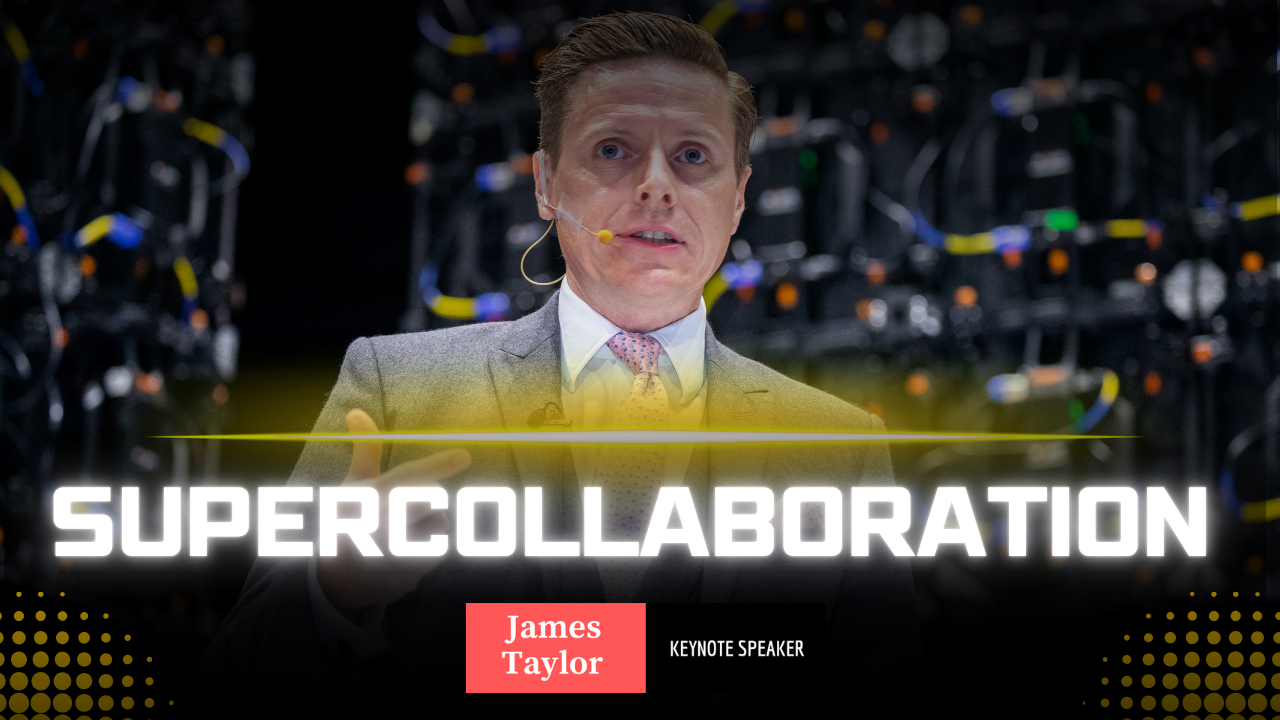
SuperCollaboration™
The series this video belongs to — how teams and organisations collaborate with each other and with AI to do their best work together.
Explore the Keynote →
If you're an event organiser searching for a motivational closing keynote speaker, this is the video to send to your committee. Filmed at the Gaylord Pacific Resort and Conference Center ahead of his second appearance at the same tech conference, James Taylor breaks down what most organisers get wrong when they book a closing speaker — it's a different job to an opening keynote, and it needs a different process.
Filmed at the Gaylord Pacific Resort and Conference Center, San Diego, CA — SuperCollaboration series. Runtime 3:50.
Approximate — single continuous take, no chapter markers in the source recording.
Most booking conversations treat the opening and closing slots as the same product in two different time slots. They aren't. An opening keynote sets the tone and energy for an event. A closing keynote has to do something harder: make sense of everything the audience already sat through.
That distinction is the whole argument of this piece to camera, filmed at the Gaylord Pacific Resort and Conference Center in San Diego ahead of James Taylor's second appearance at the same tech conference. Booking the same speaker to close an event two years running is a useful signal in itself — it means the format worked on a room the organisers know well.
"The closing keynote speaker's role is quite different to an opening keynote speaker."
— James TaylorBy the time a closing slot comes around, the room has absorbed days of content. It is tired, it is full, and it has heard a dozen or more competing ideas. A talk built for a fresh audience on day one — energy up, agenda set, expectations framed — does not land on that room. It has to be built for the moment it's actually delivered in, not adapted from an opening-keynote format.
James's process for a closing keynote begins a day or two before he speaks. He arrives early and sits in on the sessions that come before his own — not a token appearance at one or two, but the prior programme as a whole. Across a multi-day conference, that can mean roughly 15 other speakers.
He then uses AI tools to synthesise the themes running across those sessions: what keeps recurring, where speakers agree, where they quietly contradict each other, and which threads the audience has been handed without anyone yet tying them together.
"Part of the role of the closing keynote speaker is to help the audience make sense of what they've heard over the past few days."
— James TaylorThe distinction that matters here is between synthesising and summarising. A summary replays the agenda back to a room that already sat through it. A synthesis takes the threads of a multi-day conference and weaves them into one coherent narrative — with a point of view, and a big idea the audience did not arrive with.
A strong closing keynote pulls in real material from the event in the room. Photos taken during the conference. Video from the sessions. Callbacks to lines attendees actually heard from the stage two days earlier. That material is what turns a keynote into your keynote rather than a generic talk pulled off the shelf — and it is only available to a speaker who was in the building.
Inspiration on its own has a short half-life. The payoff for the audience should be concrete: one to three actionable steps they can take, or two to three key questions for leadership teams to discuss when they're back at their desks.
That's a deliberately small number. A room at the end of a multi-day event can hold a big idea and a short list — not a fourteen-point framework. The test of a close is what attendees can still repeat to a colleague on Monday morning.
Closing on a high matters emotionally, but it also matters on the balance sheet. The final session is the last impression of the entire event — the note attendees carry out of the room and into their decision about next year.
"I am the very last person that they're going to hear from on that stage."
— James TaylorOrganisers report that a strong close is what drives rebooking. That makes the closing slot one of the highest-leverage line items in an event budget, and it's why the selection process for a closing keynote speaker deserves more scrutiny than "who's available on the Thursday afternoon".
If you're shortlisting a motivational closing keynote speaker, the questions worth asking are process questions, not topic questions:
James Taylor is a motivational closing keynote speaker on creativity, innovation and artificial intelligence, working with corporate clients and associations globally — 3,000+ events delivered across 50+ countries. If your event needs a closing keynote speaker who will synthesise your conference and send attendees out ready to act, in San Diego or anywhere else, get in touch about your dates.
You can also explore James's keynote speaking programmes, the SuperCollaboration keynote this video belongs to, or his work as an artificial intelligence keynote speaker.

The series this video belongs to — how teams and organisations collaborate with each other and with AI to do their best work together.
Explore the Keynote →
A keynote built around your event: prior sessions attended, themes synthesised, and event photos and video woven into the close.
Explore the Keynote →
Creativity, innovation and artificial intelligence — the themes behind James's book and his work as an AI keynote speaker.
Explore the Keynote →An opening keynote sets the tone and energy for an event. A closing keynote has to do something harder: help the audience make sense of everything they have already sat through, and send them out with something to act on.
He arrives a day or two early and sits in on the sessions before his own, then uses AI tools to synthesise the themes running across roughly 15 other speakers. Those threads are woven together with photos and video from the event itself.
A big idea, plus something concrete: one to three actionable next steps, or two to three key questions for leadership teams to discuss when they are back at their desks.
The close is the last impression of the whole event and the last voice attendees hear. Organisers report that a strong close is what drives attendees to rebook for next year.
Yes. James works with corporate clients and associations globally and has delivered more than 3,000 events across 50+ countries. This video was filmed in San Diego, but he closes conferences worldwide.
Send your event dates, location and audience through the enquiry form on this page, email enquiries@jamestaylor.me, or message the team on WhatsApp at +971 50 474 1875.
Tell us about the event — the audience, the programme running before your close, and what you need people to do afterwards.
Complete the form and James's team will come back to you with availability, fees and the next steps.